


Find your Perfect Fit
Choose with Confidence..


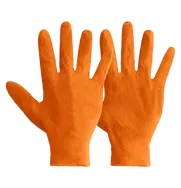


How to Measure
-
Lay your hand flat with fingers together.
-
Measure across the widest part of your palm (just below the knuckles).
-
Do not include your thumb.
UK Glove Size Guide
Palm Width (cm)UK Glove Size
7–8 cm Size 7 (Small)
8–9 cm Size 8 (Medium)
9–10 cm Size 9 (Large)
10–11 cm Size 10 (XL)
Selected products within the product range, have easy identifiable colour coded cuffs to ease with size identification.
Pink - 6 (X-Small)
Yellow - 7 (Small)
Red - 8 (Medium)
Green - 9 (Large)
Blue - 10 (X-Large)
Brown - 11 (XX-Large)
Choosing the correct safety gloves isn’t just about picking what looks tough — it’s about matching the hazards, tasks, and comfort needs of the user with the right materials, tests, and design features. A good selection protects hands from injury while allowing the wearer to work safely and efficiently.
Before selecting gloves, identify:
What hazards are present? (cuts, abrasion, puncture, heat, cold, chemicals)
How long will gloves be worn?
What task will the wearer perform?
Understanding these factors helps narrow glove options to ones that actually address the risks on the job.
EN ISO 21420 — General glove safety and comfort. EN testing standards—such as EN 388 (mechanical risks), EN 407 (heat and fire), EN 511 (cold), and EN 374 (chemical and microorganism protection)—measure how gloves perform against specific workplace hazards. These tests evaluate factors like abrasion and cut resistance, heat and cold protection, chemical breakthrough times, and water or microbial penetration. By checking the results, workers can choose gloves that match the exact risks of their job, ensuring hands are properly protected while maintaining comfort and dexterity.
EN388 — Protection against mechanical hazards like abrasion, cuts, tears, and punctures.
Check out the test evaluation number, a range of five digits, numbers and letters.
Digit 1= Abrasion score (value 0-4) Higher= withstands more rubbing cycles.
Digit 2= Blade Cut Resistance (value 0-5) Higher= better resistance to circular blade.
Digit 3= Tear Resistance (value 0-4) higher= Harder to tear.
Digit 4= Puncture Resistance (value 0-4) Higher= More force to puncture.
Digit 5= TDM Cut Resistance (value A-F) Higher letter= Higher cut force resistance.
EN407 — Thermal protection against heat and fire.
Digit 1= Burning behaviour (value 0-4) How long the glove resists burning/flame
.
Digit 2= Contact Heat (value 0-4) Max temp you can touch for 15 seconds.
Digit 3= Convective Heat (value 0-4) Protection from hot air or flame.
Digit 4= Radiant Heat (value 0-4) Protection from radiant heat (furnace)
Digit 5= Small splashes molten metal (value (0-4) Drops needed to raise the glove temp.
Digit 6= Large Quantities molten metal - Molten metal mass before damage.
EN 511 is a European standard that specifies how gloves protect against convective and contact cold. Gloves are tested and rated with three numbers, e.g., 1 2 1. Each number represents a specific test:
-
Convective cold resistance (0–4) – protection against cold air.
-
Contact cold resistance (0–4) – protection against touching cold surfaces.
-
Water permeability (0–1) – whether water penetrates the glove.
EN374 — Chemical and microorganism protection (important for chemical handling).
N 374 ensures that gloves protect against chemical penetration, permeation, and microbial hazards. It has three main parts:
-
Permeation resistance (EN 374-3) – chemical breakthrough time
-
Penetration resistance (EN 374-2) – leaks or holes
-
Microorganism resistance (EN 374-5) – bacteria/viruses
All these standards help you match glove performance to specific workplace hazards. For example, a cut‑resistant glove with a high EN388 cut level is essential in metal handling or fabrication work.
Different materials offer different benefits:
Nitrile coatings — Good general protection; resistant to oils, grease, abrasion and many chemicals.
Polyurethane (PU) — Excellent dexterity and tactile feel; ideal for precision handling.
Latex — Strong grip in wet conditions but not suited for latex allergy sufferers.
Leather — Tough and durable; excellent for heavy‑duty work like rigging or welding.
Insulated liners — Provide comfort and warmth in cold environments.
No single material protects against everything — so choose based on the specific hazard and task.
Ill‑fitting gloves increase risk. Gloves that are too loose can slip and expose skin; gloves that are too tight can restrict movement and reduce blood flow. Consider:
Hand circumference and length sizing
Dexterity needed for the task
Thickness vs. comfort balance
Snug gloves that allow free movement help ensure workers keep them on and stay safe.
Different work tasks require different features:
Mechanical risk work (cuts, abrasion):
Select gloves with high mechanical EN388 ratings and appropriate cut resistance.
Wet or oily environments:
Textured coatings or waterproof gloves help maintain grip and hand safety.
Chemical handling:
Choose gloves compliant with chemical permeation standards (EN374) and suitable materials.
Thermal hazards (heat/cold):
Look for EN407/EN511 certified gloves with appropriate insulation and resistance levels.
Trial gloves on the job when possible — samples can help ensure the glove really performs under real conditions.
Avoid choosing gloves just because they are available or cheap. A poor choice might mean higher injury risk or more replacements over time.
Don’t let workers choose their own gloves without guidance — employers are responsible for suitable PPE.
Cuff length and design influence protection and comfort:
Short cuffs for precise handling and dexterity.
Longer gauntlet cuffs for forearm protection in welding, chemical handling or hot tasks.
Choose cuff styles based on the risk exposure of the task.
The perfect fit starts here..


